
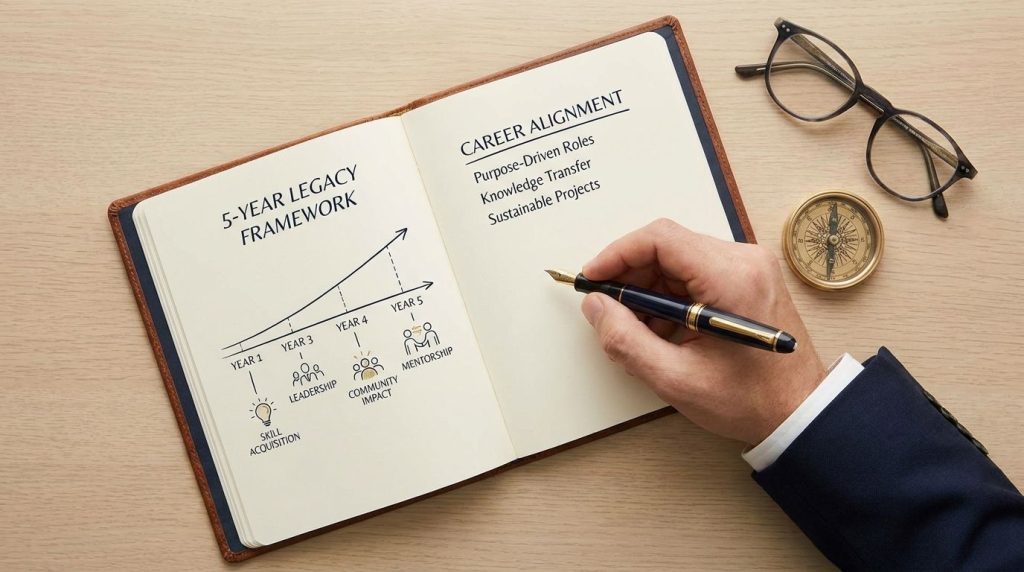
A 5-year legacy framework is a practical plan for shaping the mark you leave through your work before your career starts drifting. It turns purpose into career choices you can review, measure, and adjust across the next five years.
If your work feels busy but not meaningful, you’re not alone. Gallup has reported low global employee engagement, and McKinsey has found a wide gap between the purpose people want from work and the purpose many receive. This article helps you design a professional legacy without waiting for retirement, a title change, or permission from someone above you.
Why Most Careers Drift And How A Legacy Framework Changes That
Most careers drift because urgent work keeps beating important work. You answer messages, complete projects, attend meetings, and move from one role to the next. The calendar fills up, but the deeper question stays unanswered: what do you want your work to stand for? A professional legacy gives that question a practical place in your career decisions.
Legacy doesn’t mean fame, a corner office, or a public platform. It means the durable value people can trace back to your choices, habits, standards, mentoring, decisions, and contributions. You can build that value as a manager, independent contributor, founder, educator, analyst, operator, or specialist. Your influence starts wherever your work affects other people’s ability to learn, decide, serve, build, or grow.
The 5-year legacy framework works best when you treat it as a design cycle, not a rigid life script. You create a direction, test it through real work, gather feedback, and refine your next move. That matters because values can sharpen, goals can change, and your role can shift. A good plan gives you direction without trapping you.
Year 1: Clarify Your Core Values And Legacy Vision
Your first year is about clarity, not speed. Before you choose a major project or public goal, define what kind of contribution would feel worth the effort. Start by naming three to five core values that you want your work to reflect. Then turn those values into a short legacy vision you can use when deciding where to spend your time.
A useful legacy vision is specific enough to guide choices, but flexible enough to survive career change. “Be successful” is too broad. “Help early-career professionals build confidence through clearer feedback and better learning systems” gives you something to act on. It points toward people, problems, behaviors, and outcomes.
Use your current role as your testing ground. Review your meetings, projects, relationships, and responsibilities through one question: which parts of your work already match the contribution you want to make? Then notice the gap. Your legacy vision doesn’t need to replace your job; it needs to help you shape how you show up inside it.
Year 2: Build Skills And Relationships That Match Your Purpose
Your second year turns your vision into capability. Once you know the kind of impact you want, identify the skills that would make that impact credible. These may be technical skills, communication skills, leadership skills, coaching skills, decision-making skills, or domain expertise. Choose the few that connect directly to the contribution you want to make.
Relationships matter here as much as skills. A purpose-driven career grows through trust, not solo effort. Build relationships with people who understand the problems you care about, including peers, mentors, team leads, customers, community partners, and colleagues in adjacent roles. Ask better questions, listen for recurring pain points, and look for places where your values meet real organizational needs.
This year is also where imposter syndrome can show up. You may wonder why your contribution would matter when senior leaders already have influence. Don’t wait for formal authority. Influence often begins with being the person who notices a recurring problem, learns enough to help, and earns trust through consistent action.
Year 3: Launch A Signature Initiative That Creates Visible Impact
Your third year is the point where your professional legacy becomes visible. A signature initiative is a focused body of work that expresses your values and solves a real problem. It doesn’t need to be grand. It needs to be useful, repeatable, and tied to a clear audience or outcome.
Your initiative could be a mentoring circle, a better onboarding process, a knowledge-sharing practice, a client education system, a quality improvement effort, a cross-team learning group, or a new way to document hard-won expertise. The right choice depends on your role and your organization’s needs. Select something that sits at the intersection of your legacy vision, your skills, and a problem people already recognize.
Keep the first version lean. Define the problem, the audience, the desired change, and the smallest useful launch. If your goal is mentoring, start with a structured monthly session rather than a company-wide program. If your goal is better decision-making, create a practical checklist or review process before proposing a major operating change.
Year 4: Amplify Your Voice Through Thought Leadership
Your fourth year is about helping your ideas travel beyond your immediate workload. Thought leadership does not require celebrity, constant posting, or self-promotion. It means you share useful lessons from your work in a way that helps other people think, decide, or act better. Your voice becomes part of your impact.
Start with the channels that fit your environment. You can write internal guides, present lessons learned to your team, lead a workshop, contribute to a professional community, speak on a panel, publish articles, or create a practical resource others can reuse. The goal is not visibility for its own sake. The goal is transfer: helping people benefit from what you’ve learned.
Use a simple filter before sharing anything. Ask whether the idea is grounded in real work, whether it helps a defined audience, and whether it connects back to your legacy vision. This keeps your thought leadership from becoming noise. It also protects your time because you’ll share fewer things with better purpose.
Year 5: Scale, Sustain, And Mentor For Lasting Influence
Your fifth year asks a different question: can the impact continue without you holding every piece together? A professional legacy becomes stronger when other people can carry, adapt, and improve the work. That means you need systems, documentation, ownership, and mentoring. The work should become easier for others to repeat.
Scaling doesn’t always mean making something bigger. It can mean making it steadier, clearer, more teachable, or better connected to the organization’s routines. If you created a mentoring program, train new mentors and document the structure. If you built a learning resource, create a simple update process. If you improved a workflow, make the method easy for another team to adapt.
Mentoring is one of the cleanest ways to extend your professional legacy. You help someone build judgment, confidence, skill, and standards that they can use long after a project ends. Mentoring also keeps legacy from becoming self-centered. It moves the focus from “What will people remember about you?” to “What will other people be able to do because of your contribution?”
Overcoming Fear, Time Pressure, And Shifting Goals
Fear often appears when legacy starts to sound too large. You may feel pressure to define one grand mission for your entire career. Don’t do that. Work with a five-year chapter instead, because a chapter gives you direction without pretending you can predict every role, market shift, or personal change ahead.
Time pressure is real, so your plan has to fit inside the work you already do. Use existing projects as raw material. Add a legacy lens to performance goals, team rituals, mentoring conversations, documentation, client work, or process improvements. You don’t need a separate life to build meaningful impact; you need clearer intention inside your current one.
Your values can also change during the five years. That doesn’t mean the plan failed. Review your legacy vision every quarter and rewrite it when your lived experience gives you better language. The point is not to protect an old version of the plan; it’s to keep your choices aligned with the person and professional you’re becoming.
How To Measure Meaningful Impact Without Losing Yourself
Meaningful impact can be measured, but it needs more than numbers. Start with three types of evidence: outcomes, behavior change, and durability. Outcomes show what improved. Behavior change shows whether people adopted a better way of working. Durability shows whether the value continues after the first push.
Use practical indicators that match your initiative. If you mentor, track retention in the program, participant progress, promotion readiness, skill confidence, or feedback quality. If you improve a process, track cycle time, rework, adoption, clarity, or reduced friction. If you build thought leadership, track reuse of your materials, invitations to teach, better decisions made from your guidance, or questions that show people are applying the ideas.
Protect yourself from turning legacy into another performance treadmill. Your measurements should guide learning, not punish you. Review what worked, what drained you, who benefited, and what needs to change. Meaningful work should ask effort from you, but it should not erase your health, boundaries, or relationships.
How To Get Support From Your Employer Or Team
Your employer is more likely to support your legacy plan when you connect it to shared goals. Translate your personal purpose into business, team, customer, or talent outcomes. A manager may not respond to “I want to build my legacy,” but they may support “I want to improve onboarding so new hires reach full contribution faster.” Same intention, stronger language.
Bring a small proposal instead of a vague aspiration. Define the problem, who benefits, what you’ll build, the time needed, and how success will be reviewed. Keep the first version manageable. Leaders tend to support plans that reduce friction, develop people, improve quality, or protect knowledge.
You can also ask for support without asking for permission to become someone else. Request feedback, access to stakeholders, time to pilot an idea, or sponsorship for a learning opportunity. The best legacy plans serve your growth and the organization’s needs at the same time. That balance makes the work easier to defend and easier to continue.
What Is A 5-Year Framework For Designing A Professional Legacy?
- Year 1: Define values.
- Year 2: Build skills and allies.
- Year 3: Launch one impact project.
- Year 4: Share useful ideas.
- Year 5: Mentor others and sustain the work.
Build The Next Five Years Before They Disappear
A 5-year legacy framework gives you a way to stop treating meaning as something that may arrive later. You define what you stand for, build the skills and relationships to support it, create a visible contribution, share what you learn, and help others carry the work forward. The plan should stay flexible, because your goals and values can sharpen through experience. What matters is that you stop letting your calendar make every decision for you. Five years from now, your professional legacy will reflect either drift or design, and design gives you the better story.