
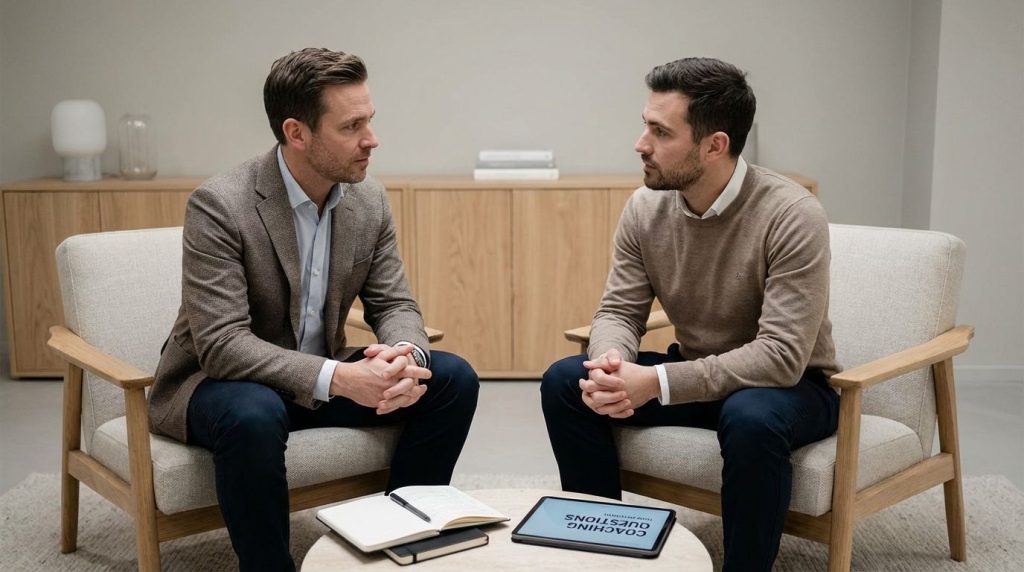
Powerful questions help you build a team that thinks, decides, and grows without waiting for you to solve every problem. When you lead with coaching questions instead of instant answers, you create stronger ownership, better judgment, and more consistent performance across your team.
If you want fewer dependency loops, better one-on-one meetings, and more capable employees, coaching is one of the most useful management habits you can build. This article shows you which questions work, why they work, and how to use them in real conversations so your team becomes more confident, more accountable, and easier to lead.
What Are The Best Coaching Questions To Ask Your Team?
The best coaching questions are short, open-ended, and focused on helping the employee think more clearly. They do not corner people, signal the answer, or force a defensive explanation. They move the conversation toward clarity, options, ownership, and action.
If your team regularly brings problems to you, the fastest fix is rarely another answer from the manager. It is a better question. One well-timed question can uncover the real obstacle, expose missing thinking, and help the employee arrive at a stronger decision without being carried there.
A useful coaching question usually does one of four things. It helps the employee define the issue, examine what has already been attempted, explore alternatives, or commit to a next step. When you keep your questions in those lanes, your conversations stay practical instead of drifting into vague discussion.
These are some of the strongest questions to use in day-to-day management:
- What is the real challenge here for you?
- What have you tried so far?
- What else could you do?
- What is getting in the way?
- What support do you need from me?
- What will you do next?
- How will you know this is working?
Those questions work because they put responsibility back where it belongs, with the employee, without sounding cold or dismissive. You stay engaged, but you stop becoming the automatic source of every answer. That shift matters more than many managers realize. Gallup has reported that managers account for as much as 70% of the variance in team engagement, which means your day-to-day conversation habits shape how people perform, contribute, and stay connected to the work.
The strongest leaders also know when to keep quiet after asking the question. A rushed manager often asks something useful and then answers it on behalf of the employee two seconds later. Coaching only works when you leave enough room for thinking. Silence is not awkward in that moment. Silence is where capability starts to build.
How Do Powerful Questions Help Employees Grow Instead Of Relying On The Manager?
Employees grow when they practice judgment, not when they outsource judgment upward. If people keep bringing every decision to you, they may look engaged, but what you actually have is a dependency pattern. The short-term gain is speed. The long-term cost is a team that hesitates, waits, and asks for permission too often.
Powerful questions interrupt that pattern. When you ask, “What do you think the next move should be?” or “Which option makes the most sense and why?” you shift the mental work back to the employee. That matters in every environment, from frontline operations to senior professional roles, because ownership grows through repetition.
Many managers assume employees ask for answers because they do not know what to do. In real workplaces, that is only part of the story. Often the employee has a likely answer already but wants reassurance, cover, or approval. When you keep stepping in too early, you train people to seek certainty from you instead of building confidence in their own reasoning.
This is one reason coaching creates stronger teams over time. It makes people sort through tradeoffs, identify risks, and own consequences. They stop treating every issue as something to be escalated immediately. Instead, they start arriving with options, recommendations, and a clearer understanding of what they actually need from you.
The manager’s workload changes too. Answer-first leadership feels efficient in the moment, yet it creates repeat traffic. Question-first leadership can take a little longer in one conversation, but it reduces recurring interruptions and builds better decision-making capacity across the team. Over a quarter, that difference becomes visible in speed, quality, and independence.
Research also supports the value of stronger manager coaching. Gallup’s workplace findings show that teaching managers effective coaching techniques can lift manager performance and improve employee engagement. That matters because coaching is not just a softer communication style. It is a practical performance lever tied to how people think, work, and contribute.
If you want your team to solve more without you, stop rewarding dependence with instant solutions. Reward thinking. Ask what they see, what they recommend, and what they plan to do. Then hold them to the answer they give.
What Should Managers Ask In A One-On-One Meeting?
A strong one-on-one meeting is not a status update with nicer language. It is a focused conversation that helps you monitor progress, surface blockers, develop judgment, and strengthen trust. If your one-on-ones are filled with project recaps you could have read in a dashboard, you are wasting one of the best leadership tools you have.
The most effective one-on-one questions cover current work, obstacles, team relationships, growth goals, and support needs. You are not aiming for a script. You are building a repeatable conversation pattern that helps employees think clearly and speak honestly. That is where coaching questions become useful.
Start with work in motion. Ask what the employee is focused on, where progress is strong, and where friction is building. Keep the question open enough to invite reflection, but specific enough to produce a real answer. “What are you working on and how is it going?” remains effective because it gives the employee space to define what matters most.
Then move to blockers. Many managers ask, “Any blockers?” and get a quick “No.” That question is too easy to dismiss. Better questions uncover more detail. Ask, “What is slowing you down right now?” or “Where are you spending more energy than expected?” Those questions lead to more honest answers and better discussion.
Development belongs in the meeting too. If one-on-ones only cover delivery, you miss the chance to build future capability. Ask, “What skill do you want to strengthen next?” or “Where do you want more stretch in your role?” That keeps growth connected to the actual work instead of turning it into a separate annual exercise.
Support should be addressed directly. Ask, “What support from me would help most right now?” This keeps your role clear. You are not there to take work away from the employee. You are there to remove obstacles, sharpen priorities, and help the employee move with confidence.
These questions work well in recurring one-on-ones:
- What are you focused on right now?
- What is going well?
- What is harder than it should be?
- What is getting in your way?
- What decision are you sitting on?
- What skill do you want to build next?
- Where do you need support from me?
- What will you do before our next meeting?
There is also a strong engagement case for improving these conversations. Gallup has tied manager quality closely to employee engagement, and Microsoft WorkLab has found that employees who talk with their manager about how they work best report stronger support. That means your one-on-one meeting is not just an operational check-in. It is one of the places where performance, trust, and retention get shaped in plain view.
If your one-on-ones feel flat, the issue is usually not frequency. It is the quality of the questions. Upgrade the questions, and the meeting becomes more useful almost immediately.
How Do You Stop Solving Your Team’s Problems And Start Coaching?
Most managers do not become the bottleneck on purpose. They become the bottleneck because they are competent, fast, and used to being the person with the answer. The habit gets reinforced every time an employee arrives with a problem and leaves with a solution supplied by the manager.
To break that cycle, you need a pause between problem and answer. That pause is where coaching begins. When someone brings you an issue, do not open with advice. Open with a question that makes the employee define the situation more clearly. Ask what the real issue is, what has been attempted, and what options are already on the table.
This does not mean becoming passive. It means resisting the urge to take over too soon. You are still leading the conversation. You are still accountable for standards and outcomes. You are simply refusing to do the employee’s thinking before the employee has done any.
One of the simplest ways to implement this is to set a default response pattern. When someone asks, “What should I do?” answer with one of these:
- What options have you considered?
- What do you recommend?
- What have you tried so far?
- What is the risk if you choose option A over option B?
- What support do you need from me to move forward?
This keeps the conversation productive without dropping the employee into the deep end. The employee still gets your involvement. What changes is the order. Thinking comes before advice.
Timing matters. Managers usually fall back into answer mode when they are rushed. When your schedule is packed, it feels easier to give the solution and move on. That choice solves the immediate interruption, but it also trains the team to return with the next issue. If you want to stop carrying every decision, you need consistency during the busiest parts of the day, not only when you feel patient.
It also helps to separate urgent issues from coachable issues. If the matter is time-sensitive, regulated, or high-risk, direct instruction may be necessary. If it is a routine decision, a planning issue, a people issue, or a recurring obstacle, coaching usually delivers more long-term value. Strong managers know the difference and switch modes deliberately.
Another practical move is to require options, not just problems. Tell your team to bring at least one recommendation when they escalate an issue. That small rule changes the quality of what reaches you. It reduces vague handoffs and encourages employees to think through tradeoffs before they ask for your input.
Stopping the rescue habit also improves your credibility. Employees quickly learn whether you mean it when you say you want ownership. If you claim to empower people but constantly override, redirect, or answer too soon, your message and your behavior do not match. Coaching closes that gap.
What Makes A Coaching Question Effective?
An effective coaching question is clear, open, neutral, and anchored to action. It invites reflection without sounding scripted, vague, or accusatory. If a question makes the employee defend past behavior instead of examine what to do next, it is usually the wrong question.
The wording matters more than many managers expect. A small shift in phrasing can change the tone of the whole exchange. “Why did you do that?” often feels like a charge to answer. “What led you to that decision?” opens the door to explanation, reasoning, and learning. The difference is subtle, but employees feel it immediately.
Good coaching questions are also short. Long questions usually contain hidden advice, assumptions, or two or three prompts packed together. That makes them hard to answer and easy to dodge. Ask one thing, then stop. The cleaner the question, the better the thinking you tend to get back.
Another mark of a strong coaching question is that it keeps ownership with the employee. If the question points everything back to the manager, it weakens the conversation. “Do you want me to tell you what to do?” may sound helpful, but it trains dependence. “What path makes the most sense to you?” keeps responsibility in the right place.
These pairs show the difference between weak and effective coaching language:
- Weak: Why did you do that?
Better: What led you to that decision? - Weak: Did you ask for help?
Better: Where would added support make the biggest difference? - Weak: Do you understand the goal?
Better: How do you see the goal, and what is still unclear? - Weak: Have you fixed it yet?
Better: What progress have you made, and what remains unresolved? - Weak: Why are you stuck?
Better: What is making this harder than expected?
Effective coaching questions also match the moment. When someone is unclear, ask a clarity question. When someone is stuck, ask an options question. When someone is drifting, ask an accountability question. When someone needs support, ask a resource question. You do not need a giant script. You need the discipline to ask the right kind of question at the right time.
Performance management guidance often emphasizes this same principle: open-ended questions lead to stronger conversations than closed or leading ones. That matters in reviews, one-on-ones, project debriefs, and development talks. A good question creates room for useful information to surface. A poor one shuts the discussion down before it starts.
Natural delivery matters too. If your question sounds borrowed from a leadership seminar, employees will hear it and disengage. Use plain language. Speak the way you normally speak, but with more care and more intention. Coaching works best when the question sounds real, direct, and relevant to the employee’s actual work.
How Can Coaching Questions Improve Employee Engagement And Performance?
Coaching questions improve engagement and performance by giving employees more clarity, more ownership, and better manager support. People perform better when they know what matters, have room to think, and feel that their manager is helping them succeed without controlling every move.
Gallup’s workplace research has made the manager’s influence hard to ignore. When managers account for a large share of team engagement differences, everyday conversations stop being a soft skill issue and become an operating issue. The quality of your questions affects how people interpret expectations, confidence, autonomy, and support.
That is one reason coaching has measurable value. Gallup has reported that teaching managers effective coaching techniques can improve manager performance by 20% to 28%. It has also reported stronger engagement outcomes among trained managers and their teams. Those numbers matter because they connect coaching behavior to real business outcomes, not just manager preference.
Coaching questions help engagement in several practical ways. They give employees a voice in how work gets done. They surface obstacles before frustration hardens into disengagement. They connect daily work to growth. They also show respect. When you ask someone to think, evaluate, and choose, you communicate trust in a way that a quick instruction never can.
Performance improves through the same mechanism. Better questions lead to better problem definition. Better problem definition leads to better decisions. Better decisions reduce rework, confusion, and avoidable escalation. Over time, you get a team that handles routine issues faster, raises risks earlier, and contributes stronger ideas.
This matters even more in flexible and hybrid work settings, where communication quality often replaces proximity as the main driver of alignment. Microsoft WorkLab has reported that employees who discussed how they work best with their manager were more likely to say their manager supported their desired work style. That points to a simple truth: better manager conversations create stronger working conditions.
Engagement also rises when employees feel seen as professionals, not just task executors. Coaching questions signal that you care about how people think, how they solve, and how they want to grow. That strengthens commitment because the employee is participating in the work, not just receiving it.
If you want stronger performance, do not limit your attention to task assignment and deadline follow-up. Improve the quality of the conversations that happen before, during, and after the work. Questions are one of the most efficient tools you have for doing that at scale.
What Are Examples Of Coaching Questions Managers Can Use Right Away?
The best coaching questions are the ones you can remember under pressure and use without sounding rehearsed. You do not need a giant library. You need a short set of reliable prompts that fit your real meetings, project reviews, and one-on-one conversations.
Start with questions that map to common management moments. When an employee is stuck, ask a problem-solving question. When someone needs development, ask a growth question. When ownership is fuzzy, ask an accountability question. When workload or friction is getting in the way, ask a support question. This keeps your coaching practical and easy to repeat.
Use these questions for problem-solving:
- What is the real issue here?
- What have you tried so far?
- What else could you do?
- Which option do you recommend?
- What risk do you need to manage?
Use these questions for accountability:
- What outcome are you aiming for?
- What will success look like?
- What will you do by the end of the week?
- What might prevent follow-through?
- How will you keep this on track?
Use these questions for development:
- What skill do you want to strengthen?
- Where do you want more responsibility?
- What part of this work will stretch you most?
- What did you learn from that outcome?
- What would you do differently next time?
Use these questions for support and collaboration:
- What support from me would be most useful?
- Who else needs to be involved?
- Where is coordination breaking down?
- What information are you missing?
- What would make this easier to execute?
Use these questions in one-on-one meetings:
- What deserves attention right now?
- What is going well that should continue?
- What feels harder than it should?
- Where are you carrying too much friction?
- What do you need from me before our next conversation?
Keep the list visible until the habit becomes automatic. Save it in your meeting notes, print it, or add it to your one-on-one agenda. Repetition matters. If you only coach when the mood feels right, you will default back to giving answers when pressure rises.
It also helps to repeat a few signature questions often enough that your team starts to expect them. That creates a useful cultural shift. Employees come prepared for thinking, not just reporting. Over time, they start answering the questions before you ask them, which is a strong sign that your coaching habit is working.
How Do You Build A Coaching Habit Without Sounding Scripted Or Fake?
The fear many managers have is simple: coaching questions can sound forced. That happens when the wording is unnatural, the timing is off, or the manager asks a polished question with no real intention to listen. Employees can spot that immediately.
The solution is not to avoid coaching language. The solution is to make it sound like your language. Use direct phrasing that fits your style, your team, and the moment. If “What is the real challenge here for you?” feels too formal, say, “What is the real issue?” The substance matters more than the exact wording.
You also need to match your tone to the employee’s state. If someone is frustrated, overloaded, or under pressure, a detached coaching line can feel irritating. Start by acknowledging the reality of the moment, then move into the question. A small amount of human awareness makes the coaching feel supportive instead of mechanical.
Consistency helps more than polish. If you ask thoughtful questions regularly, employees stop treating them as a technique and start seeing them as your normal management style. The discomfort tends to fade once people realize your questions are meant to help them think, not test them.
Another useful rule is to avoid stacking questions. Ask one, wait, then follow the answer. When managers pile on too many prompts, the conversation starts to feel performative. Clean exchanges feel more natural, and they produce better answers.
Book summaries of The Coaching Habit have helped popularize this idea by emphasizing simple, repeatable questions rather than long coaching models. That has appeal for busy managers because it keeps coaching grounded in real conversations rather than formal sessions. If you stay direct, listen well, and use the questions to create better thinking, you will not sound fake. You will sound prepared.
What Are The Best Coaching Questions For Managers?
- Ask open-ended questions that build ownership.
- Use prompts like: What is the real issue, what have you tried, what else could work, what support do you need, and what will you do next?
- Keep questions short, neutral, and action-focused.
Lead With Questions And Watch Your Team Get Stronger
If you want a team that thinks well, acts with more ownership, and relies less on constant manager rescue, coaching needs to become part of your daily management rhythm. Strong coaching questions improve one-on-one meetings, sharpen accountability, strengthen engagement, and help employees build judgment that lasts beyond the current task. You do not need a complicated playbook to make this work. You need better questions, more patience after you ask them, and the discipline to stop answering too soon. When you lead that way consistently, your team becomes more capable, your time gets used more effectively, and your leadership starts producing leverage instead of dependence.
References
- Gallup, State of the Global Workplace Report: https://www.gallup.com/file/workplace/659528/state-of-the-global-workplace-2025-download.pdf
- Gallup, Who Drives Employee Engagement — Manager or CEO?: https://news.gallup.com/opinion/gallup/186503/drives-employees-engagement-manager-ceo.aspx
- Microsoft WorkLab, To Thrive in Hybrid Work, Support Flexibility in Work Styles: https://www.microsoft.com/en-us/worklab/work-trend-index/support-flexibility-in-work-styles/
- People Managing People, 50 Performance Review Questions To Ask In 2026: https://peoplemanagingpeople.com/performance-management/performance-review-questions/
- BobbyPowers.com, Book Summary: The Coaching Habit: https://bobbypowers.com/review-the-coaching-habit/
- Reddit r/managers, What Questions Are You Asking Your Reports During 1:1s?: https://www.reddit.com/r/managers/comments/1fideut
- Reddit r/Leadership, Questions That Put The Ball Back In The Employees Court: https://www.reddit.com/r/Leadership/comments/1ewtat1
- Reddit r/Leadership, Stop Solving Your Team’s Problems: https://www.reddit.com/r/Leadership/comments/1jzm4ww